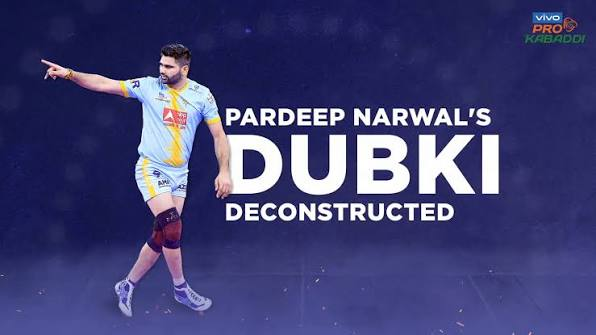

Pardeep Narwal’s name became closely connected with one technique in kabaddi: the Dubki. The move looks simple when executed well. A raider lowers his body, passes beneath or through the defenders attempting to stop him and escapes toward the midline. In practice, the technique requires timing, balance, awareness and an ability to predict how defenders will commit to the tackle. Narwal turned those elements into a repeatable attacking weapon.
The attraction of the Dubki comes partly from the uncertainty immediately before contact. Defenders know Narwal may attempt it, but they cannot commit too early without creating another route for him. That tension can resemble the changing outcomes associated with a fortune garuda 500 slot game, although Narwal’s success is based on reading opponents rather than chance. The Dubki works because he recognizes the moment when a defensive formation has shifted from control into commitment.
What the Dubki Actually Requires
The Dubki is often described as ducking underneath defenders, but this explanation leaves out most of its mechanics.
The raider first needs defenders to move toward him.
If they remain at a safe distance, there is no tackle to escape. Narwal therefore uses positioning, changes of pace and body movement to encourage defenders to close the space.
Once they commit, he lowers his centre of gravity and drives through the gap created by their movement.
Balance is essential.
A raider who bends without maintaining forward momentum can be trapped on the floor. Narwal’s execution combines the drop with enough leg drive to continue toward the midline.
The move is therefore both evasive and directional.
Timing Matters More Than Surprise
Defenders have known about Narwal’s Dubki for years. The fact that the move remained effective demonstrates an important principle: a technique does not need to be secret if the timing is difficult to counter.
The defender has several responsibilities during a raid.
He must maintain formation, protect space, communicate with teammates and decide when to attempt contact. Narwal can use those responsibilities against the defence.
If a defender moves too early, the raider can change direction. If defenders wait too long, he may secure a touch and retreat.
The Dubki becomes available between those two moments.
Narwal often waits until multiple defenders believe they have closed the route. Their confidence in the tackle can create the opening he needs.
Defensive Commitment Creates the Opportunity
Kabaddi defence depends heavily on coordinated movement.
A single defender making an isolated tackle can expose the entire unit.
Teams therefore try to trap raiders through combined actions, with one defender initiating contact while others close escape routes.
The Dubki attacks this coordination.
When defenders converge, their bodies naturally create different levels and angles. Arms may move toward the upper body while another defender prepares to block the legs.
Narwal lowers himself before the structure fully closes.
The same coordination designed to remove space can briefly produce a narrow route underneath the tackle.
This is why the move is particularly effective when defenders become aggressive.
Narwal’s Body Position Helps Sell Other Options
Before attempting the Dubki, Narwal does not always signal that he intends to go low.
He can remain upright, move laterally and approach defenders as though he is preparing for a hand touch or another escape route.
This forces defenders to consider several possibilities.
The key moment occurs when their body weight begins moving toward him.
Changing direction becomes harder once a defender’s momentum is committed. Narwal can then lower his body while the opponent is still reacting to the previous movement.
His setup is therefore as important as the escape itself.
Without that preparation, defenders could simply lower their own stance and remove much of the available space.
The Move Became a Psychological Weapon
Repeated success changes how opponents defend.
Once the Dubki became associated with Narwal, defenders had to consider it during every raid.
That creates a psychological advantage even when he does not use the technique.
A defender worried about a low escape may hesitate before committing to an upper-body tackle. Another may maintain a lower stance, making lateral movement more difficult.
Narwal can exploit those adjustments with other raiding methods.
This is one reason signature moves remain useful after opponents have studied them.
The move itself becomes only one part of the threat. The expectation of the move changes defensive behaviour before it happens.
Why Copying the Dubki Is Difficult
The visible mechanics can be imitated.
Many raiders can lower their body and attempt to move beneath a tackle. Reproducing Narwal’s success is harder because the technique depends on information gathered before contact.
The raider needs to understand which defender is likely to initiate the tackle, how quickly support will arrive and where the escape route will exist.
A fraction of a second matters.
Going down too early gives defenders time to adjust. Going down too late means contact has already restricted movement.
The technique also requires confidence.
A failed Dubki can leave the raider in a poor position, surrounded by defenders with little opportunity to recover.
Repeated success therefore depends on judgment rather than courage alone.
A Signature Move Can Shape a Career
Sport often remembers athletes through actions that compress their broader skill set into one recognizable image.
For Narwal, the Dubki became that image.
This does not mean his career can be explained by one technique. Successful raiding requires footwork, awareness, touch skills, tactical discipline and an understanding of match situations.
However, the Dubki gave those abilities a recognizable expression.
It also helped establish an identity. Opponents prepared for it, spectators expected it and analysts used it to explain his approach to raiding.
Few techniques become so closely connected with one player.
More Than a Spectacular Escape
The Dubki is memorable because of how it looks, but its tactical logic is what made it sustainable.
Narwal does not simply throw himself beneath defenders and hope to escape. He creates the conditions for the move by drawing defenders forward, reading their commitment and choosing the moment when their structure becomes vulnerable.
That distinction explains why the technique became his signature.
Its effectiveness comes from a sequence: preparation, defensive reaction, body drop, forward drive and escape.
The final movement receives the attention, but everything before it makes the action possible.
Pardeep Narwal’s Dubki demonstrates how a sporting signature is created. A technique becomes iconic not because nobody else can attempt it, but because one athlete understands when and how to use it better than the players trying to stop it.